
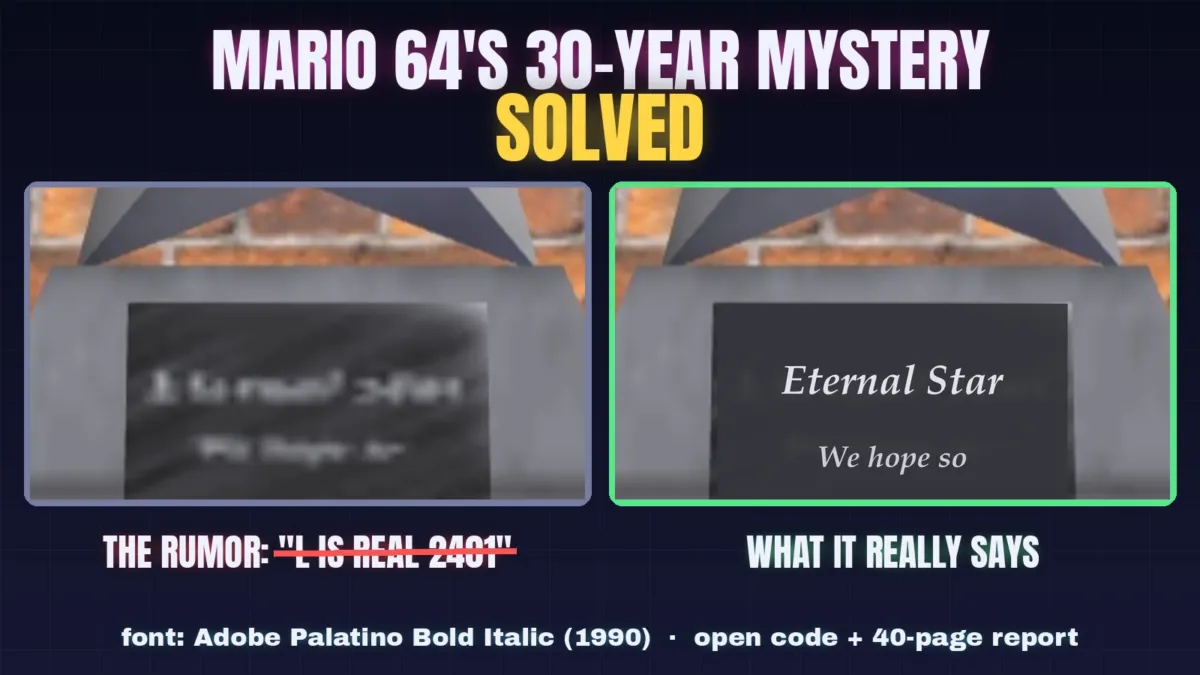
The blurry plaque in Super Mario 64‘s castle courtyard has a new answer. A programmer’s open-source project rebuilt the 32×32 texture the way a Nintendo artist would have made it in 1996, and says the sign reads “Eternal Star / We hope so” rather than “L is real 2401”.
The plaque is a single 32×32 gray texture, and its two lines of text are three to five pixels tall. Eternal Star is the name players gave the statue standing in the fountain. For most of the last three decades its plaque was read as “L is real 2401”, which players took as proof that Luigi was hiding somewhere in the game. Nintendo Power ran the theory in issue 107 in April 1998 as fake “April News Briefs”, teasing a Luigi 64 game and promising a code on page 128 of a magazine with 106 pages. A letter Nintendo sent to a player, recovered by a fan and quoted by Kotaku, called the inscription a joke. Shigeru Miyamoto explained in a Japanese strategy guide, since translated, that Luigi was cut because of memory limits.
Mochi64, a programmer who posts on YouTube, published the project on GitHub in mid-October and posted the answer at Nintendo about 40 minutes later, saying he used AI models to crack it. The tool does not try to read the pixels. It works backwards from the way a 1996 artist would have made the sign. The steps are plain: type a line in a period font, shrink it to 32×32, add blur and gamma, lay it on the stone, then score how close the result lands. Millions of fonts, settings and candidate strings were tested on a GPU. The test setup was calibrated first against fake plaques with known text.
Palatino Bold Italic is the typeface that came out on top of a search of roughly 530 fonts an artist could have used in the mid-1990s, and “Eternal Star / We hope so” won the text. The project reports that “L is real 2401” fits about twice as badly. For example, “Eternal” ranked first among 1,237,405 candidate strings in a blind search, and a blind test with 50 secret words planted in the plaque returned the right word as the best real-word match every time. The texture is identical in every regional release, so no version hides different words.
Read the way the project reads it, the sign looks like a Japanese memorial plaque: a name and a wish, in the style of 永遠の星, “an eternal star”. This is a fan effort, not a Nintendo release, and every artifact, such as the code and the test data, is public. The creator invites readers to beat his score, and Nintendo has not confirmed the reading.
The same plaque also turned up in The Legend of Zelda: Ocarina of Time, which is one of the facts that broke the Luigi theory in the first place. That game’s remake lands on Switch 2 on November 5 (our release-time guide). Anyone who wants to look at the original pixels can pull up Super Mario 64 in the Nintendo 64 app on Nintendo Switch, which Nintendo’s own store page lists as a Nintendo Switch Online + Expansion Pack title.
The interesting part is not that a 30-year-old rumor lost. It is that the winning phrase was one fans had already proposed, because “Eternal Star” is the name the statue carries. Kotaku’s history of the craze records that some players read the plaque that way long before any tool existed. The project did not uncover a secret message. It explains why the nonsense reading spread so well: somebody typed a real, deliberate dedication in a 1990 font, and it looks like noise until someone runs the process backwards. For anyone still hunting for Luigi in the castle, the tool settles the other half of the puzzle too, because the pixels are the same in every release.
Edited by Kerwin Stewart, Editor-in-Chief · How we report



Comments
Join the discussion Does 'Eternal Star / We hope so' settle the Luigi theory for you, or is it just a better-looking guess?
Loading comments…