
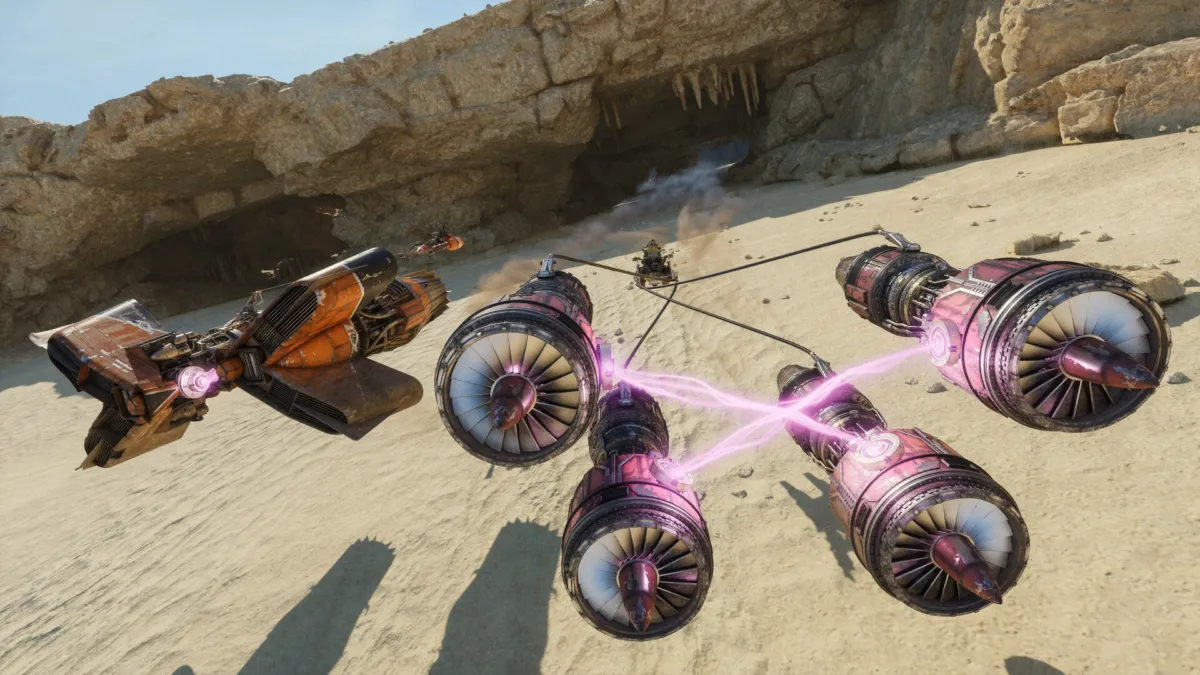
Star Wars: Galactic Racer is the rare Star Wars launch that arrived almost entirely under the radar and is now one of 2026’s best-reviewed games on consoles. The roguelike racer from Fuse Games and publisher Secret Mode is sitting on a Metacritic score of 88 for the PS5 version, with VGC handing it a 5/5 (“a modern racing classic”), GameSpot a 9/10 (“my favorite racing game in years”), and Eurogamer a perfect 5/5 (“absolute racing paradise”). On Steam, the game has pulled a 24-hour high of 10,449 concurrent players since tracking began on launch day, with a $59.99 Standard and $79.99 Deluxe edition on the store page.
The more interesting story is how it was made. Speaking to GamesIndustry.biz at Game Republic New Horizons this week, Fuse Games CEO Matt Webster said the game’s core team “averaged a lot smaller than” 75 through most of the production cycle, even though Fuse is aiming for what he calls “Premier League level” work. The company got there with what it calls distributed development: three tiers of external partners standing in for the in-house studio most AAA projects would have built.
How ‘distributed development’ splits the work
The three tiers, from furthest to closest to the core team:
- Outsourcing. Art assets and similar production work handled by external teams, often in lower-cost locations. Webster: “You give a brief, you get an output back, and you integrate it in. Which sounds transactional, but you shouldn’t treat it as transactional.”
- External development. A self-contained chunk of the game handed to a third party. Galactic Racer’s photo mode, for example, was built lock, stock, and barrel by an outside studio, including its own production, art, UI, and code.
- Co-development. Outside teams fully embedded in Fuse’s workflow. “They are, to all intents and purposes, an extension of our team. They just happen to work for another company,” Webster said. All of Fuse’s co-dev partners are UK-based, partly to keep time zones aligned.
The model is also a deliberate answer to the boom-and-bust staffing pattern of traditional AAA development. “When you shrink, there’s a personal impact to people, but you also lose an incredible amount of knowledge, which I think is probably way more expensive to retrieve,” Webster said.
What we know about launch and reviews
Webster is cautious about sales, telling GamesIndustry.biz it’s still “too early to tell” after one weekend. The game launched on PS5 and PC on October 6, 2026, and Steam tracking shows a 10,449-player 24-hour peak since we began sampling it today. Reviews continue to land, but the PS5 critical score has already settled at 88, in the same league as 2025’s best-reviewed racing releases.
Galactic Racer sits in a small 2026 cohort of games made on a deliberately small core team but with publisher-funded scale around it. Secret Mode itself is a newly independent UK publisher, and Hell Let Loose developer Expression Games, also UK-based and recently Manchester-located, confirmed it worked on the title. The lesson Webster keeps repeating is that distributed development “can’t just be applied”; “you’ve got to configure your studio with it from the start,” he said. Whether the model holds up across a full franchise cycle is the part Fuse still has to prove.
Edited by Kerwin Stewart, Editor-in-Chief · How we report


Comments
Join the discussion Would you rather see more AAA Star Wars games made by 75-person teams like Fuse, or by huge in-house studios like the one behind GTA 6?
Loading comments…