
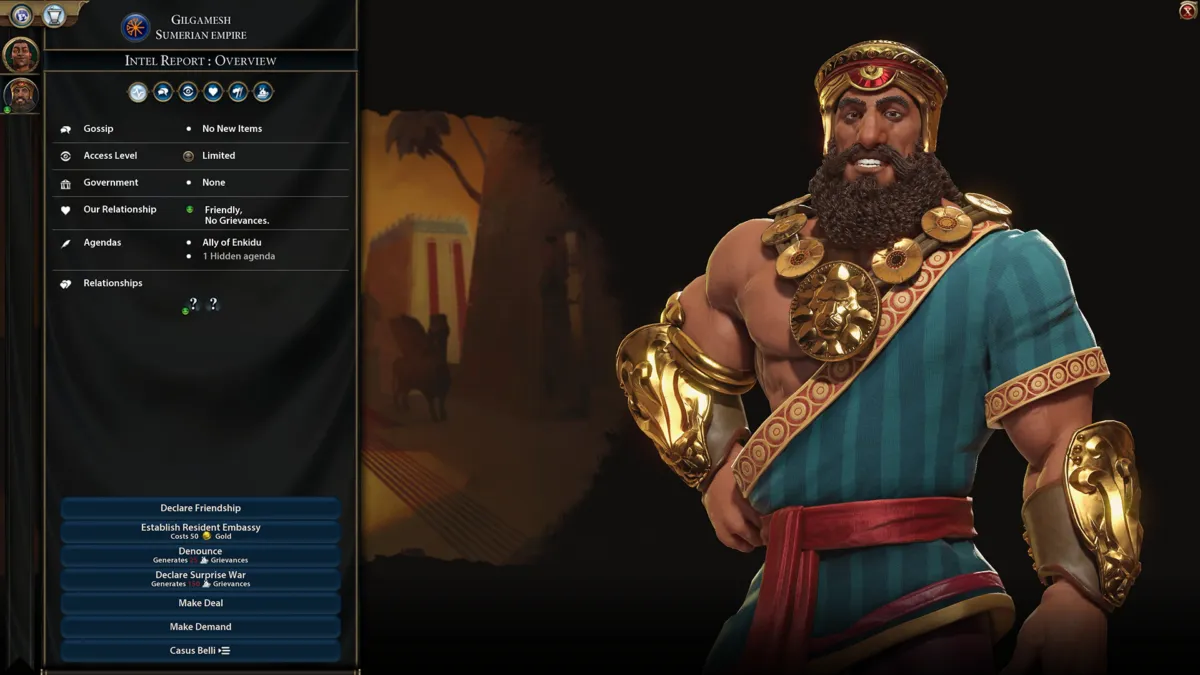
Sid Meier’s Civilization VI launched on Windows on October 21, 2016, ten years ago this week. Firaxis Games’ sixth mainline entry in Sid Meier’s 4X strategy series pushed buildings outside the city center for the first time, ran a separate civic tree alongside the tech web, and turned a 25-year-old formula into the most-played Civ on Steam.
4X is a strategy genre built on four verbs: explore, expand, exploit, and exterminate. The Civilization series has been the genre’s defining example since 1991, and the gap between Civilization V in 2010 and Civilization VI in 2016 was the longest mainline pause in the franchise’s history.
What it was like at launch
Civ VI arrived as Firaxis’s first Civ game in six years, after Civilization V’s 2010 launch. It won Best Strategy Game at The Game Awards 2016 and Strategy/Simulation Game of the Year at the 20th Annual D.I.C.E. Awards, per the Wikipedia summary of the title’s reception. Critics pointed to the new district system, which let players specialize cities around terrain: a Campus next to mountains for science, a Commercial Hub on rivers for gold, an Industrial Zone on resources for production. The old “everything in the city center” model finally broke.
Two expansions followed in the next three years. Rise and Fall launched on February 8, 2018, adding Golden Ages, Dark Ages, and a loyalty mechanic that let nearby cities defect. Gathering Storm landed on February 14, 2019, and layered climate change, natural disasters, and the World Congress onto the same map. Firaxis followed them with the New Frontier Pass (2020-21) and the Leader Pass (2022-23), which together added dozens of new leaders and a steady drip of paid content. By the time the sequel launched in February 2025, Civ VI had become the most-supported entry in franchise history.
What it changed
The “unstacked cities” decision rippled through the genre. Humankind (Amplitude, 2021), Old World (Mohawk Games, 2022), and Ara: History Untold (Oxide, 2024), the post-2016 wave of historical 4X games, all borrowed the district model in some form. Civ VI also doubled down on terrain-aware bonuses: adjacency rules meant placing a Holy Site next to a natural wonder or a Campus near mountains gave meaningful science or faith, instead of generic flat yields. The post-2016 wave of strategy coverage has tracked the same shift: our guide to Total War: SHOGUN 2’s remaster backlash ran into the same question of whether a strategy game’s design choices survive contact with the people who played it at launch.
Civ V’s separate civic progression (which had run alongside the tech tree in V) became a full second tree in VI, so science and culture games finally felt like different campaigns. AI opponents got secret agendas and randomized agenda sets, so the same civ behaved differently across runs instead of running the same code path every game. Twelve languages were in the launch version, per the Steam store page.
The ports mattered as much as the design. Aspyr Media shipped the iPad version in December 2017, the Switch version on November 16, 2018, the Linux port on February 9, 2017, and the PlayStation 4 and Xbox One versions on November 22, 2019. The Switch port in particular made a long single-player strategy game viable on a handheld for the first time, and the iOS/Android versions opened the franchise to a much wider mobile audience. By 2026, Civ VI ran on Windows, macOS, Linux, iOS, Nintendo Switch, PS4, Xbox One, and Android. The full release history is on the Release Calendar.
Civ VI platform launches by date
| Platform | First launch date | Source |
|---|---|---|
| Windows | October 21, 2016 | Wikipedia / Steam store page |
| macOS | October 24, 2016 | Wikipedia |
| Linux | February 9, 2017 | Wikipedia |
| iOS (iPad) | December 21, 2017 | Wikipedia |
| Nintendo Switch | November 16, 2018 | Wikipedia |
| PlayStation 4, Xbox One | November 22, 2019 | Wikipedia |
| Android | August 13, 2020 | Wikipedia |
Where to play it today
The base game is $59.99 on Steam and the Sid Meier’s Civilization VI Anthology bundle (base game plus 18 DLC packs including both expansions and the Leader Pass) is $98.70 with no current discount, per the Steam listing. The Anthology is the one to grab if you’re starting fresh: Gathering Storm and Rise and Fall are the must-have expansions, and the Leader Pass adds 18 leader variations for replay value. We counted 19 items in the Anthology bundle: the base game, two expansions (Rise and Fall and Gathering Storm), and 16 DLC packs covering extra civilizations, leaders, and scenarios.
Outside Steam, you can pick up Civ VI on the PlayStation Store (PS4), Microsoft Store (Xbox One), Nintendo eShop (Switch), App Store (iOS/iPadOS), and Google Play (Android). Pricing on mobile storefronts tends to run cheaper than the PC base price but mobile versions don’t always carry the full DLC catalog in the same form.
If you own Civ VI on Steam and pick up Civilization VII, the cross-promo runs the other way. Linking your 2K Account from Civ VI unlocks Napoleon Bonaparte with his Revolutionary Persona as a free leader in Civ VII, per the 2K cross-promotion noted on the Steam store page. It’s not a discount on Civ VII, just a free character.
Civ VII and what Firaxis is still shipping
Civilization VII launched on February 11, 2025, on Windows, macOS, Linux, Switch, PS4, PS5, Xbox One, and Xbox Series X|S. Firaxis followed with a Switch 2 version on June 5, 2025, and brought the game to iOS, tvOS, and visionOS via Apple Arcade on February 5, 2026. The Civ VII launch split the player base: it was mostly well received but more divisive than past entries, with critics praising the new ages system and visuals while hammering the UI for not explaining itself. Firaxis’s most significant post-launch patch so far, the “Test of Time” update, addressed those critiques.
Civ VI itself has no announced remaster. It still has an active player base on Steam (per our Player Counts tracker, which samples Steam every hour), a decade of community mods on the Workshop, and a complete DLC roster behind it. The strategy genre’s October 2026 slate doesn’t include a new 4X, per our Release Radar for October 12-18 and Morning Save Point for October 14, so Civ VI and VII remain the two heavyweight strategy games in the discourse right now. If you want the modern Civ experience today, Civ VII is the move. If you’d rather replay the older game you already know by heart, Civ VI is the one with the deeper mod scene and the friendlier learning curve. Either way, both are still being patched in 2026.
Our read: The “unstacked cities” mechanic is the single design choice that defined the last decade of 4X, and Civ VI is where it lived first. We counted 19 items in the Steam Anthology bundle against the Wikipedia list of platforms and ports, and Firaxis’s expansion cadence (two expansions plus two season passes in five years) was the most aggressive post-launch support cycle the franchise had ever shipped. The 2016 entry is the one every competing 4X still has to answer to: Humankind‘s culture wheel, Old World‘s dynasty orders, and Ara: History Untold‘s settlement event cards are all riffs on Civ VI’s adjacency-and-district loop. Firaxis took a six-year gap between V and VI and spent it on a structural rewrite rather than a feature dump, and that gamble is what made the new template stick. Ten years on, you can still feel the same decision pressure on every Campus placement, and that is why people are still booting up the 2016 version in 2026.
Edited by Kerwin Stewart, Editor-in-Chief · How we report





Comments
Join the discussion Are you still booting up Civilization VI in 2026, or did Civilization VII win you over?
Loading comments…