
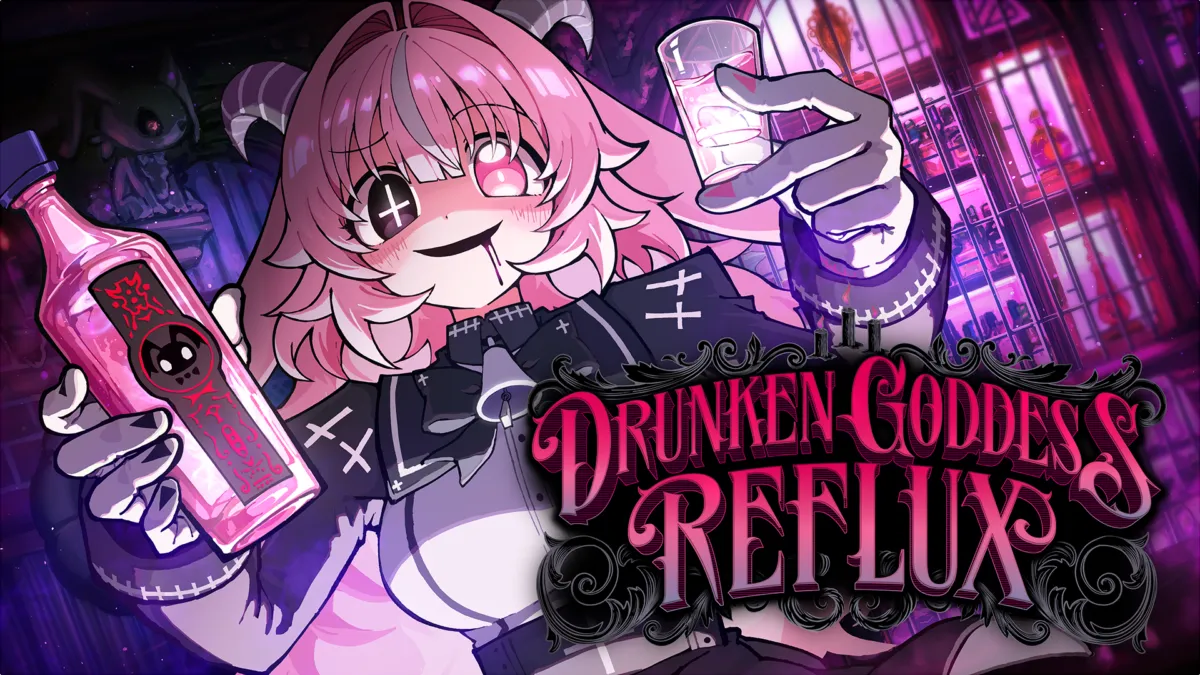
Alliance Arts has cancelled the public demo for its upcoming Drunken Goddess Reflux, originally scheduled for Monday, October 19. It is replacing the public demo with a closed Discord playtest open only to applicants willing to sign an agreement that bans AI training, AI analysis, and creating “substantially identical” copies. Drunken Goddess Reflux is a Russian-roulette-style drinking survival game from Alliance Arts’ in-house “WHO YOU” Discord community (WHO YOU is the Discord server name Alliance Arts uses for the Yunyun Syndrome!? and PUKEY GODDESS SHOT TRICK community, which now extends to Drunken Goddess Reflux).
The Tokyo-based publisher cited two reasons. It could not enforce posting and streaming restrictions on a public demo. And it feared that the demo’s content could be cloned with AI and released ahead of the full game.
“We are concerned that, based on the content of the demo, works imitating or replicating this game’s presentation and gameplay could be quickly produced using AI or other tools and released ahead of the game’s launch,” Alliance Arts wrote in its English-language announcement. The publisher still wants players to try the game before launch. It will hold closed online play sessions from Friday, October 23 to Saturday, October 31, 2026 JST, with applications due by October 22, 11:59 PM JST via the official “WHO YOU” Discord. Slots are selected by lottery.
The playtest agreement goes further than most. Article 10 prohibits “Creating, publishing, distributing, or selling any Copy of the Game.” It also prohibits using the build or its content “for AI training (including additional training and the creation of datasets for such purposes),” letting “any AI analyze” the build, disassembling or reverse-engineering the build, and, before release, “using the Playtest Build to create, publish, distribute, or sell any game or other work that imitates the Game.” It defines a “Copy” as any software “substantially identical to the Game, regardless of how it is created (including by copying the Game’s programs or data, by manual recreation, or by using generative AI).”
The closure fits a pattern that has hardened in 2026. Developers are going private with pre-release builds because the open-internet surface area no longer feels safe. Konami defended the role of “real people” over AI in its latest integrated report yesterday. The Black Myth: Zhong Kui team announced it won’t use AI earlier this month. And Game Freak shut down major post-launch updates for Beast of Reincarnation earlier this week, partly because the small-studio bandwidth for AI-driven imitation concerns has gotten thin.
Alliance Arts is putting the policy in the contract rather than the press release. Any playtest participant who lets AI train on or analyze the build forfeits their access. They become liable to legal action under the Tokyo District Court jurisdiction clause. The Alliance Arts framing of “Copy” is unusually broad: it captures generative-AI outputs, manual recreations, and “any AI analyze” steps, not just direct code copying. For a small publisher without the budget of a Konami or a Game Science, that kind of legal scaffolding is the cheapest deterrent available. For readers who follow how studios are responding to generative AI, this is one of the most concrete protective playtest contracts published so far.
Drunken Goddess Reflux is on Steam (appid 4150720) with a release date still TBA. The Steam page and Discord agreement are the only public surfaces for the game right now. For readers who wanted to play the public demo, the swap is a disappointment. For readers who wanted a real-world template of an anti-AI playtest clause, it is now the cleanest one to point at.
Edited by Kerwin Stewart, Editor-in-Chief · How we report

Comments
Join the discussion Are anti-AI playtest agreements the new normal, or is Alliance Arts overreacting?
Loading comments…