
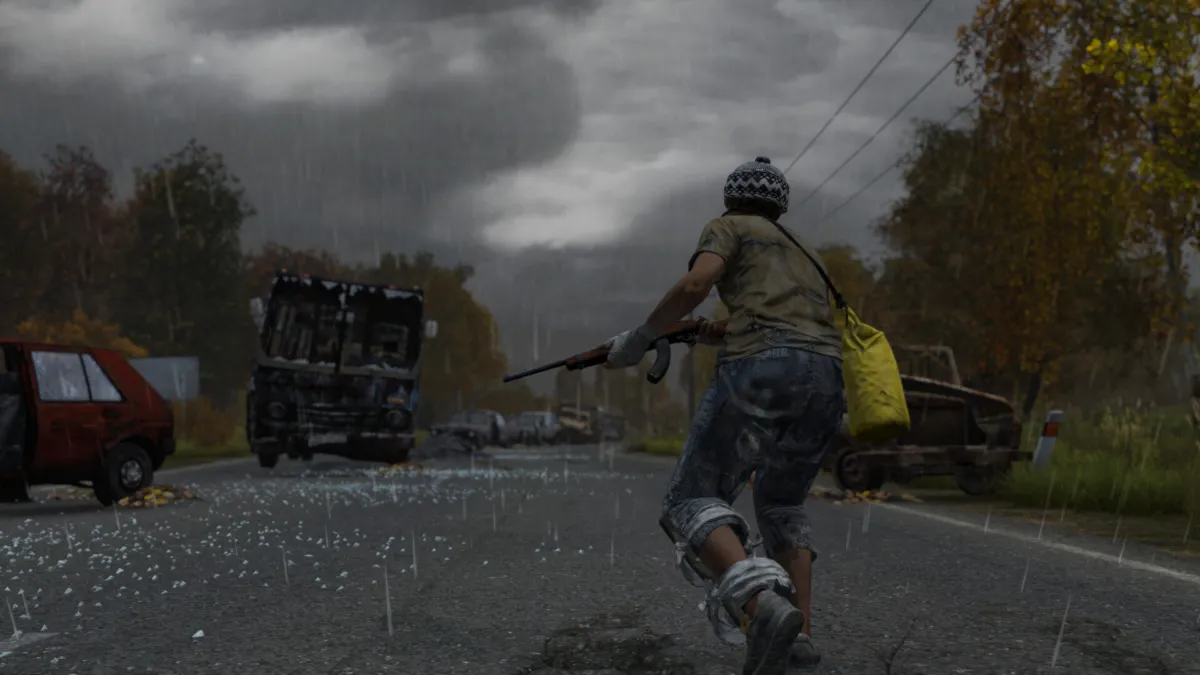
DayZ creator Dean Hall and his studio RocketWerkz have released Brutal, a free, open-source C# framework designed to give developers a way to “break free of Unity” and Unreal Engine. Hall announced the project Wednesday in a lengthy post to the r/gamedev subreddit, and the timing lines up with one of the year’s biggest under-the-hood wins: RimWorld just shipped a Steam beta of an entirely new engine, Waylith, built on top of Brutal.
Brutal is a collection of software and tools, not a full game engine. Hall describes it as a foundation developers can build their own engine on, or use directly to ship a game. The license is permissive: free for commercial use, no royalties, with the only ask being a copyright notice in credits, the Brutal logo on startup, and the Brutal notice in project files. “You are only as independent as your tools are,” Hall writes. “This technology is a small step towards changing the balance of power.”
The two highest-profile adopters are Tynan Sylvester, creator of RimWorld, and Felipe Falanghe, creator of Kerbal Space Program. Sylvester’s studio Ludeon announced Waylith this week, claiming “performance is improved by 2-4x” in tests and confirming the new RimWorld beta doesn’t break mods (see our RimWorld 1.7 coverage). Ludeon also hinted Waylith will power the studio’s next game. Falanghe, who says he left KSP “with no rights to it 8 years prior” and has since “battled uphill to do a job that was feeling more and more untenable,” used Brutal for his own next project and says it’s “very very close to being showable.” RocketWerkz’s upcoming game Kitten Space Agency also uses Brutal directly. DayZ itself, the Bohemia Interactive survival game that made Hall’s name, launched on its own proprietary engine back in 2013 (see our DayZ Badlands expansion coverage for where the franchise is in 2026).
Hall frames the release as a direct response to what he sees as a worsening relationship between developers and the two biggest engine holders. “I have watched Unity and Unreal consistently fail to be accountable to developers,” he writes, and points to Unity’s 2023 install-fee push as the warning shot. He also flagged Unreal’s 5% royalty on revenue above the licensing threshold and said he was “not satisfied” with Tim Sweeney’s response to a GDC 2025 Tencent Summit question about Unreal’s accountability to developers. (“Make more demos and put them on social media to counter people describing games as ‘Unreal slop,'” Hall paraphrases.)
The push comes as AI agent-led development, reverse-engineering, and recompilation are “accelerating” what Hall calls “the rot” in the games industry. He worries that as those workflow advantages erode, “the companies involved will increasingly look to extract more revenue from developers who feel they cannot switch. Whether through royalties, subscriptions, or more restrictive licensing.” The framing lands in the same conversation as Activision’s QA strike vote and the broader AI-in-games worker pushback we covered earlier this week (Modern Warfare 4 Strike Vote, Project Hadar’s years-out pre-production).
Hall was careful to credit the team behind Brutal rather than position it as a solo project: “Loads of people at RocketWerkz built this thing,” he writes, and noted “we also have new people joining us from some of the world’s largest game companies, bringing their experience to this effort.”
Brutal vs Unity vs Unreal
| Brutal | Unity | Unreal Engine | |
|---|---|---|---|
| License | Open source | Proprietary | Proprietary |
| Royalties | None | None for most seats; install fee debated in 2023 | 5% on revenue above $1M, after first $1M |
| Form | Framework, foundation for a custom engine | Full engine plus Asset Store | Full engine plus Megagrant program |
| Notable adopters | RimWorld (Waylith), KSP creator’s next game, RocketWerkz’s Kitten Space Agency | Slay the Spire 2, Vampire Survivors, thousands of indies | Fortnite, Final Fantasy VII Rebirth, hundreds of AAA |
| Performance profile | 2-4x perf bump reported in RimWorld Waylith beta | Engine-typical; performance debated after 2023 fee | Engine-typical; FPS, frame generation features |
What players get
The closest preview of what a Brutal-future looks like is already in players’ hands. RimWorld’s Steam beta on Waylith reports a 2-4x performance bump with the same look and gameplay, and it’s mod-compatible. Ludeon’s stress test cut a 1,500-mod modpack load from 14 minutes to 6 minutes. If Sylvester’s next title ships on the same foundation, players can expect the same win: faster loads, higher frame rates, fewer hitches, with creators keeping full control of the engine layer. Falanghe’s adoption also matters for anyone waiting on his next project, which has been in limbo for years.
Hall’s bigger argument is that the engine choice matters at the bottom of the market, not just the top. Unity’s 2023 install-fee saga and Epic’s 5% Unreal royalty are both pricing decisions that flow downstream to the games themselves, and Brutal’s “no royalties, fork the code if you want” pitch is a direct counter. Hall explicitly says that anyone is free to fork the framework if RocketWerkz itself ever stops being accountable to developers.
Our read: The RimWorld Waylith timing is what makes this news, not just a Twitter-thread-shaped manifesto. A Steam beta with a 2-4x perf boost, mod-compatible, from a studio that just crossed 12 years on a single game is the proof that the framework works under real shipping pressure. The bigger question is whether the Unity and Unreal royalty pressure Hall describes ever forces more mid-sized studios to follow Sylvester’s lead, or whether Brutal stays a niche foundation for the kinds of projects where engine ownership is worth the trade-off in tooling and ecosystem.
Edited by Kerwin Stewart, Editor-in-Chief · How we report


Comments
Join the discussion If a 2-4x performance boost is possible by switching engines, should more studios follow RimWorld's lead and leave Unity or Unreal behind?
Loading comments…