
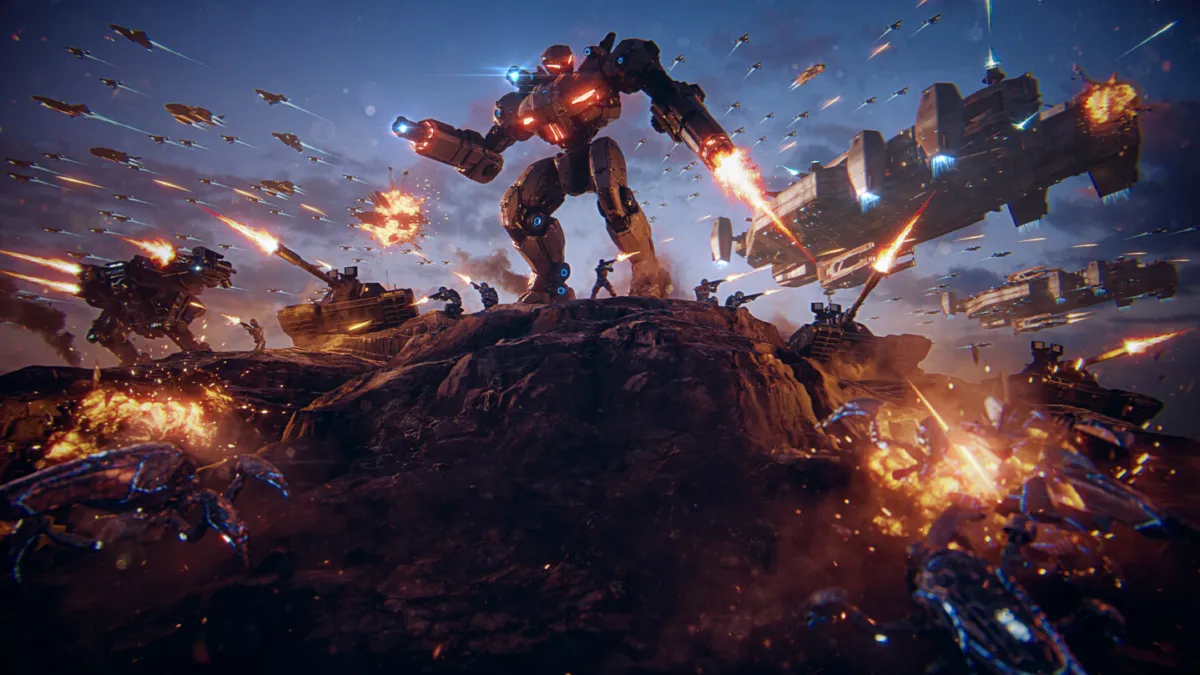
Ashes of the Singularity II is a real-time strategy game where you command thousands of units, not squads. That is the single biggest thing to understand before you buy it. Oxide Games calls it a “macro-RTS” and says players should expect to be ordering 50 or more units almost immediately, with the average battle running 100 or more. If you are coming from a classic base-building RTS, the learning curve runs in the opposite direction from what you expect. You will spend less time placing buildings and more time positioning armies and reading the ground.
The game launches on PC on November 10, 2026. This guide covers what the developers have actually shown about the Army system, the Power economy and the terrain tactics, so you can start on day one with a plan.
What is Ashes of the Singularity II?
It is the sequel to 2016’s Ashes of the Singularity, developed by Oxide Games and published by Stardock. The story is a near-future war for the solar system between three factions. Humanity’s United Earth Forces fight the Post-Human Coalition, a faction of humans who abandoned their physical bodies and now outpace humanity in technology. The third side is the AI Substrate, the rogue artificial intelligence that has built a machine civilization of its own.
You lead the United Earth Forces in the campaign. In skirmish and multiplayer, all three factions are playable, and each one has its own units, strategies and philosophy. Stardock’s official release announcement describes the same three-way conflict. Strategic Zoom is the camera system the store page lists, and it is how you pull back from the front line to orbital command and then drop into it again.
Should you start with the campaign, Instant Action or multiplayer?
There are three ways to play, and the Steam store page lists all of them.
| Mode | What it is | Who it suits |
|---|---|---|
| Campaign | A single-player story where you are a Commanding Officer of the United Earth Forces fighting Post-Human expansion and Substrate machinations | Players who want the narrative and the United Earth Forces |
| Instant Action | You pick the battlefield and fight computer-controlled opponents, which Stardock says are designed by some of the most experienced RTS developers in the industry | New players learning the Army system without a campaign to finish |
| Multiplayer | Competitive PvP and cooperative team battles, all online on Steam | Players who want to fight other people |
A July developer journal shows skirmish gameplay against three Regular AI players, and it focuses on a feigned retreat used to break through well-defended choke points in the early and mid-game. If you have never played an army-scale RTS, that is the least complicated place to learn, because you pick the map and play against the computer. Multiplayer is the opposite bet: the September public playtest ran from September 8 to 14 on Steam with the United Earth Forces and the Post-Human Coalition, and joining took a single click with no key to wait for.
How do you control 100-plus units?
This is the part that trips up new players, and the answer is Armies. In a developer journal from July 1, Oxide’s Brett writes that Armies are control groups with a higher level of intelligence. They are the first thing you start interacting with in the game, not a shortcut you unlock later once seven units are on screen.
Three practical consequences follow from that:
- You order armies, not units. Getting an artillery army into position early matters more than placing each gun perfectly.
- You can still be precise when it matters. Brett is explicit that tactical micromanagement is still possible by ordering specific units instead of the whole army.
- The battlefield is much larger than you are used to. He says the average scale of combat is “often being 100+ units”, and that battles can grow even larger on big maps and in team games.
What is the Power system, and how does it change your base building?
In a September 25 developer journal, BATTLEMODE walks through a new Building Construction system and the Power mechanic: “Many Buildings can be constructed in a single Region now, limited by the Power in the region.”
Power is the regional budget that decides how many buildings you can put in one region. It is a budget you spend on structures instead of a number you click past. If you are used to building as fast as your resources allow, you now have to choose what each region spends its power on. That is a different kind of decision, and it happens earlier in the game than a base-building RTS would ask it of you.
What wins a battle: terrain, chokepoints and artillery?
Stardock’s 2026 developer journals are unusually consistent about this. What each one shows:
- Chokepoints (August 12): terrain, chokepoints, flanking maneuvers, and artillery used to pound a kill zone.
- Bring the Right Weapon (August 21): long-range turrets placed on higher terrain are protected from return fire.
- God’s Oven (August 29): a way to counter massed tank formations.
- Terrain Trap (September 6): trapping enemy formations against terrain features.
- Fighting Retreat (August 5): a desperate gambit to stall an attack long enough for an ally to come to the rescue.
- Running the Gauntlet (October 28): blocking units and mortar emplacements doing heavy damage to closely clustered armored formations.
- Ashfall Caldera (October 8): a small skirmish map where trenches and gullies funnel armies into a labyrinth of choke points.
Two rules fall out of that list. High ground matters, because turrets up there take less return fire. And an army that bunches up in a narrow pass is an army that mortars can punish, so the shape of the formation walking into a choke point matters as much as the one holding it.
What is the Unit Upgrades system?
A July 10 journal introduces Unit Upgrades. The example is the Post-Human Coalition Commander. It starts as a basic starter unit and can become a battle-hardened veteran with more health, stronger weapons and even a new offensive drone bay module. The Hyperion dreadnought gains health and weapon damage upgrades of its own.
Stardock is upfront about the risk: everything you put into an upgraded unit is lost if that unit dies in battle. Upgrades are a commitment, not a menu to tick on the way past.
Is it friendly to new players?
Steam’s own feature list for the game is more generous than most RTS stores. It includes Adjustable Difficulty, Playable without Timed Input, Save Anytime, Adjustable Text Size, Custom Volume Controls, Partial Controller Support, Steam Cloud and Family Sharing. Save Anytime and Playable without Timed Input matter most in a game where a single battle can run long, because you can stop mid-fight and you are never forced into a timed click to keep up.
What do you need to run it?
Windows 10 or 11, 64-bit only, with 50 GB of storage and an SSD recommended. The minimum is a Ryzen 5 2400G or an Intel i5-8500 with 8 GB of RAM and an RX 580 8GB or GTX 1660 6GB, on DirectX 12. The recommended spec is a Ryzen 5 5600X or an i5-11600K with 16 GB of RAM and an RX 6750 XT 8GB or RTX 3070 8GB. It is a PC game, and no console version has been announced.
Our PC specs and Steam Deck page has the full requirement list, the file size and the current Steam Deck status, including what Valve has and has not published. The Ashes of the Singularity II hub keeps the dates, prices and every story we run in one place.
Frequently asked questions
Is Ashes of the Singularity II coming to console or cross-platform?
No. Steam lists Windows only, and Stardock’s launch announcement describes a PC release. No console version has been announced, so there is no cross-play question to answer yet.
What time does Ashes of the Singularity II launch on November 10?
The Steam unlock is at 9:00 a.m. EST on November 10, which is 2:00 p.m. UTC and 2:00 p.m. GMT, and Stardock’s release livestream starts four hours later at 1:00 p.m. EST. Our release-time guide has the full table for every time zone.
Which edition should I buy?
Two editions. Stardock’s press release puts the base game at $39.99 with a special discounted price from November 10 to 17, and the Premium Edition at $69.99 with the base game, the first three DLC packs and the soundtrack. The percentage of that launch discount has not been published. Our editions guide has both side by side.
Can I play the multiplayer before launch?
The public multiplayer playtest ran on Steam from September 8 to 14, 2026, with the United Earth Forces and the Post-Human Coalition, and Stardock says the team has been improving gameplay, balance, performance and multiplayer stability based on that feedback. The publisher’s Steam announcements through November 3 do not list another playtest.
Is there a launch-day livestream?
Yes. Stardock streams on November 10 at 1:00 p.m. EST on YouTube, Steam and Twitch, and says the team will play through the single-player campaign and multiplayer matches.
Where should I start on launch day?
Wishlist the game on Steam, take the Standard edition unless you want the soundtrack and the first three DLC packs in the Premium Edition, and keep the launch-day livestream open in a second window. It starts four hours after the game opens, and it is the easiest way to see how the developers intend the Army system and the Power economy to work before your first skirmish.
Stardock’s own journals point at one rule: the fight is usually decided before anyone shoots. Terrain, chokepoints and artillery show up in every 2026 developer journal, and the Power system turns base building into a budget choice instead of a speed run. A player who reads the ground first and spends Power on the right regions will usually get more out of a map than one who rushes units. The counterweight is the Unit Upgrades system, because Stardock says an upgraded unit loses everything invested in it when it dies, so the same patience that wins a skirmish can cost you an army. Consider watching one match on the launch livestream before you queue, since the journals show the intended way to use artillery and choke points more clearly than a single battle will.
Edited by Kerwin Stewart, Editor-in-Chief · How we report


Comments
Join the discussion Would you start with the campaign to learn the Army system, or jump straight into Instant Action skirmishes?
Loading comments…