
Ace Combat 8: Wings of Theve launched October 2, 2026 on PS5, Xbox Series X|S, and PC, and it’s the first numbered Ace Combat in seven years. Despite the 30-year franchise’s reputation for cinematic flying, it’s one of the more approachable flight games out right now: the developer built a comprehensive tutorial in response to a fanbase that kept telling them Ace Combat 7 was their entry point. If you’ve never touched the series, this guide gets you through your first sortie without burying you in jargon.
Quick answer:
- Set Expert controls on the title screen. Novice is the default, but Expert is what the game expects once you’re past the tutorial.
- Before every mission, pick your plane, weapons, and parts on the sortie screen. Don’t skip this and don’t auto-equip.
- Spend the Military Result Points (MRP) you earn after each sortie on Parts for your starter plane before you buy a new one.
- Use the countermeasure button when the missile-lock tone turns solid, not when it starts beeping.
- In cloud cover, your missile range shrinks and you lose radar; that’s a tradeoff, not a bug.
- Wingmen are an asset, not autopilot. Order them to attack, cover you, or use special weapons.
What Ace Combat 8 actually is
Wings of Theve is a 30-mission single-player campaign set in the series’ alternate-universe continent of Usea, with a separate online mode called Ace Combat Online. You fly for the Federation of Central Usea’s last air wing, Joker Flight, aboard the carrier Endurance, after the Republic of Sotoa invades with orbital kinetic-bombardment weapons called Tonitrus Spears. Your character inherits the callsign “Rex” from a fallen ace whose kill record was a propaganda fabrication. The story sits somewhere between Top Gun and a Metal Gear briefing: serious about war’s cost, prone to big set pieces, and full of in-cockpit chatter that doubles as a tutorial (IGN’s review called the campaign “earnest” and “moving”).
The campaign runs on Unreal Engine 5, with a custom cloud-rendering system called Cloudly that does real work: contrails, engine smoke, and weather are trackable on screen the way they would be in real life, not just eye candy (PC Gamer covered Cloudly in 2025). The game is the second-best-reviewed Ace Combat ever on aggregate sites, sold over one million copies by October 9 (the fastest in series history), and carries a “Very Positive” rating on Steam with about 81% of 16,000+ reviews recommending it.
Pick your control scheme: Novice or Expert
This is the one decision that changes how the whole game feels. The game ships with Novice controls, and most reviews quietly assume you’ll switch.
| Scheme | What it does | Best for |
|---|---|---|
| Novice | Banking turns auto-coordinated; the game keeps you level. Easier to track targets. | Absolute first-timers who want to learn the menus and story first. |
| Expert | Full independent control of pitch, roll, and yaw. Higher skill ceiling; you can do maneuvers Novice can’t (e.g. tight post-stall turns, knife-edge passes). | Anyone who’s flown a game like this before, or who has the patience to relearn. |
IGN’s reviewer was explicit: “you should absolutely play with the Expert scheme if you can”, because the joy is in the high-G evasion and the precise missile arcs. Eurogamer framed the same point: “those clouds aren’t only responsible for 2026’s most jaw-slackening skyboxes … visibility, after all, can be a double-edged sword”, meaning the missions are designed around you actually piloting, not rubber-banding. If you find Expert overwhelming in the prologue, drop to Novice for a sortie, then switch back: the game doesn’t lock you in.
The sortie screen, in plain English
Before every mission you pick three things, all from the same hangar menu:
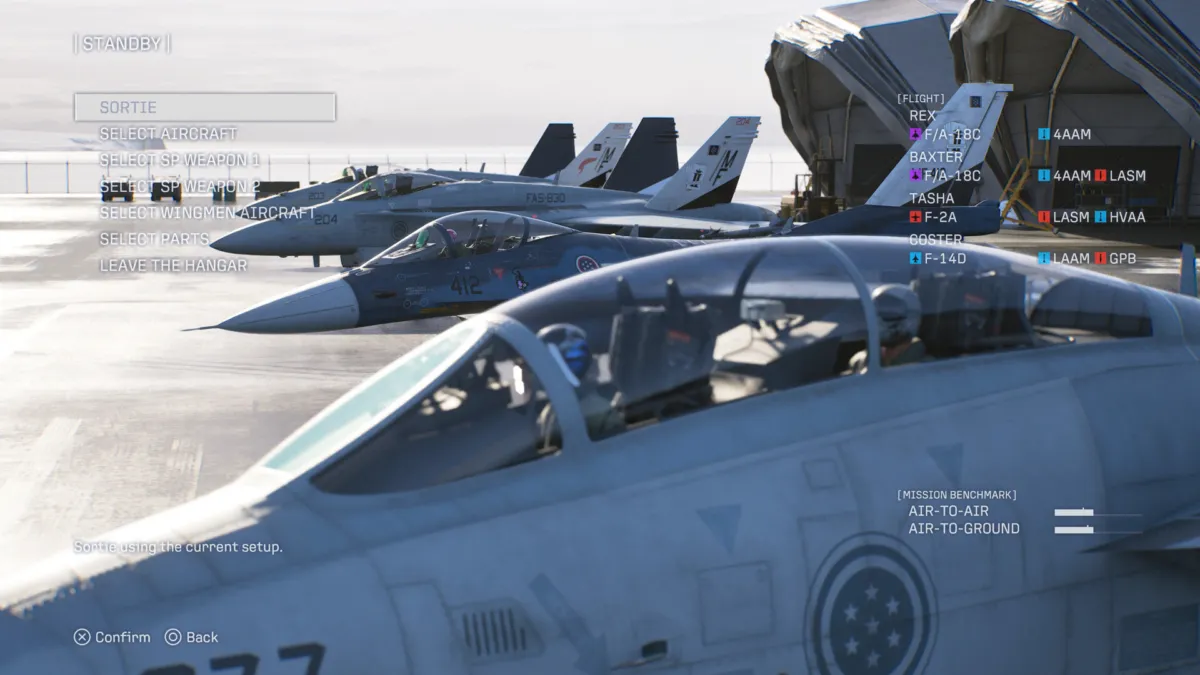
- Aircraft. There are over 30 real and fictional jets split into four categories: fighter (dogfighting), attacker (ground strikes), multirole, and electronic warfare (radar and missile jamming). Some missions restrict you to carrier-based aircraft, so a stealth attacker you love may not be available when the briefing asks for air-to-air.
- Weapons. Standard guns plus special weapons like long-range air-to-air missiles, anti-ship missiles, bombs, and electronic countermeasures. New in Wings of Theve: you can equip two special weapons instead of one, but doing so reduces the payload capacity of both (per the Wikipedia summary of preview coverage). The sortie screen shows a recommended air-to-air and air-to-ground capability rating for the upcoming mission: get close to those numbers and you’ll have an easier time.
- Parts. These are upgrades you buy with MRP, and they change how the plane handles: longer missile range, faster turning, more durability. Don’t sleep on these.
If the menu feels like a lot, leave it on auto for your first sortie to see what the game picks. From sortie two onward, hand-pick at least the special weapons.
What the first 5 sorties teach you
The campaign ramps gently. Most reviewers (IGN, Eurogamer) describe the opening as “pretty simple” objectives: defend the carrier, hit an airfield, escort a friendly plane. The point is to teach the loop without overwhelming you.
A few things to expect early:
- 3D map briefings show the area of operations. Listen to the AWACS callout, then read the map. The blue icons are friendlies, red are hostile. Your primary objective is a diamond, secondary objectives are circles.
- Optional refueling and landing minigames play before or after some missions. They’re training wheels for handling, not required.
- Joker Flight chatter is constant. Rex’s wingmates are Baxter (“Professor”), Tasha, and Coster (“Noise”). Their radio gives you targeting hints, and Noise plays rock music over comms, which is as Ace Combat as it gets.
By sortie 5, you’re expected to manage dynamic objectives: a ground detachment calling for help while transport needs intercepting, or a radar-jammed run where you have to pick out enemy contrails visually. IGN’s reviewer called these missions “a brilliant, graceful ballet where new dancers constantly take the stage”, but the first five are gentle lead-ups to that.
Combat fundamentals that pay off across all 30 missions
Four mechanics show up in every sortie:
- Countermeasures. Your plane drops flares and chaff at the same time when you hit the countermeasure button. They have a limited supply for the sortie (per the Wikipedia write-up of preview coverage). Use them when the missile-lock tone goes from beeping to solid, not the second you hear the alarm. Pre-empting wastes them and you can run out.
- Wingman Command. Hold the corresponding button to order Joker Flight to attack ground targets, cover you, or use their special weapons. They’re not on autopilot: a well-timed “use special weapons” call can clear a flight of bogeys in one pass. IGN specifically called this out as a smart use of MRP and parts.
- Dogfight Mode. A returning quick-time mechanic where the camera zooms in and you aim with finer reticle control during close-in gun runs. Triggers automatically when you get on a target’s six.
- Cloud tactics. Clouds reduce your missile lock range and visibility, but they also hide you from enemies. Long-range missiles lose you in cloud cover. The Cloudly tech makes cloud shapes tactically meaningful: contrails and engine smoke let you track enemies through the weather, the same way the pros do.
If you only master one thing, master countermeasures. Most mission deaths in the campaign come from forgetting to drop chaff at the right beat.
MRP, parts, and the tech tree loop
Every sortie pays you in Military Result Points (MRP), the in-game currency you spend on new aircraft, special weapons, and parts. The first time you beat a sortie, you’ll have enough for one or two part upgrades. Spend those on parts before you buy a new plane, because a stock multirole with better turning parts will outperform a new jet with no upgrades for two more sorties.
Eurogamer made the same point: “it’s often more sensible to invest in parts that can extend the range and effectiveness of missiles, as well as decrease your likelihood of stalling”. The recommended path is roughly:
- Sortie 1-5: Buy parts for the F/A-18C (your starter multirole). Better turning and missile-range parts carry over when you swap planes.
- Sortie 6-15: Unlock a dedicated fighter (the F-22A is a popular choice) and start spec’ing it.
- Sortie 16-30: Save up for the late-game jets and the high-end special weapons that the final missions demand.
The campaign is balanced so that you can clear all 30 missions with the F/A-18C if you spec it well, but a late-game F-22A with all parts unlocked makes the final sortie much less stressful.
Ace Combat Online at a glance
If you bounce off the campaign or just want a different pace, Ace Combat Online is the franchise’s biggest multiplayer mode to date. It runs on separate progression from the campaign, so your MRP and unlocks don’t carry over, and it uses its own in-game currency and battle pass (per the Wikipedia summary of the developer preview). The three modes to know:
- Player-vs-player matches in classic Ace Combat maps.
- Co-op player-vs-environment missions where you and other players fight the same AI force.
- Emergency Sorties, time-limited co-op events where the community fights a tough enemy ace or a returning superweapon from a previous Ace Combat.
The game has cross-platform play across PS5, Xbox, and PC, so you won’t run out of pilots (Bandai Namco confirmed crossplay on the Steam listing).
Our read
Most flight-combat games make the first three hours feel like a job application: read the manual, learn the cockpit, survive. Ace Combat 8 doesn’t, and that is the cleanest difference from the PS2-era Ace Combat games fans compare it to. The first sortie can be cleared with the tutorial on, the game gives you the option to set briefing audio to read out what each wingmate does if you missed it, and by sortie 5 you will be comfortable enough to try Expert controls. By sortie 15 the part-and-tech-tree system rewards you for the time you have put in, and the late-game missions hit harder than any flight-combat campaign since Ace Combat 4. The whole campaign is around 12-15 hours for a first playthrough on standard difficulty. Live player data tracked by Pixel Herald puts Wings of Theve at roughly 20,000 concurrent players on Steam on October 14, 2026, more than two weeks after launch — see the Steam player counts page. If you have ever wanted a clean starting point for the series, this is the friendliest one the franchise has shipped, and the launch window still has room for late adopters.
For the bigger picture, see our Ace Combat 8: Wings of Theve game page, the October 2026 releases list, the 1 million sales milestone post, and our What’s Selling roundup (which tracks Ace Combat 8’s Famitsu No. 1 in Japan). Companion launch titles we covered the same week: Castlevania: Belmont’s Curse PC specs and Steam Deck status and Castlevania editions breakdown.
Edited by Kerwin Stewart, Editor-in-Chief · How we report



Comments
Join the discussion What was the moment the Ace Combat 8 campaign finally clicked for you?
Loading comments…